Latest Blog

Commercial Tile Installation in Fresno County

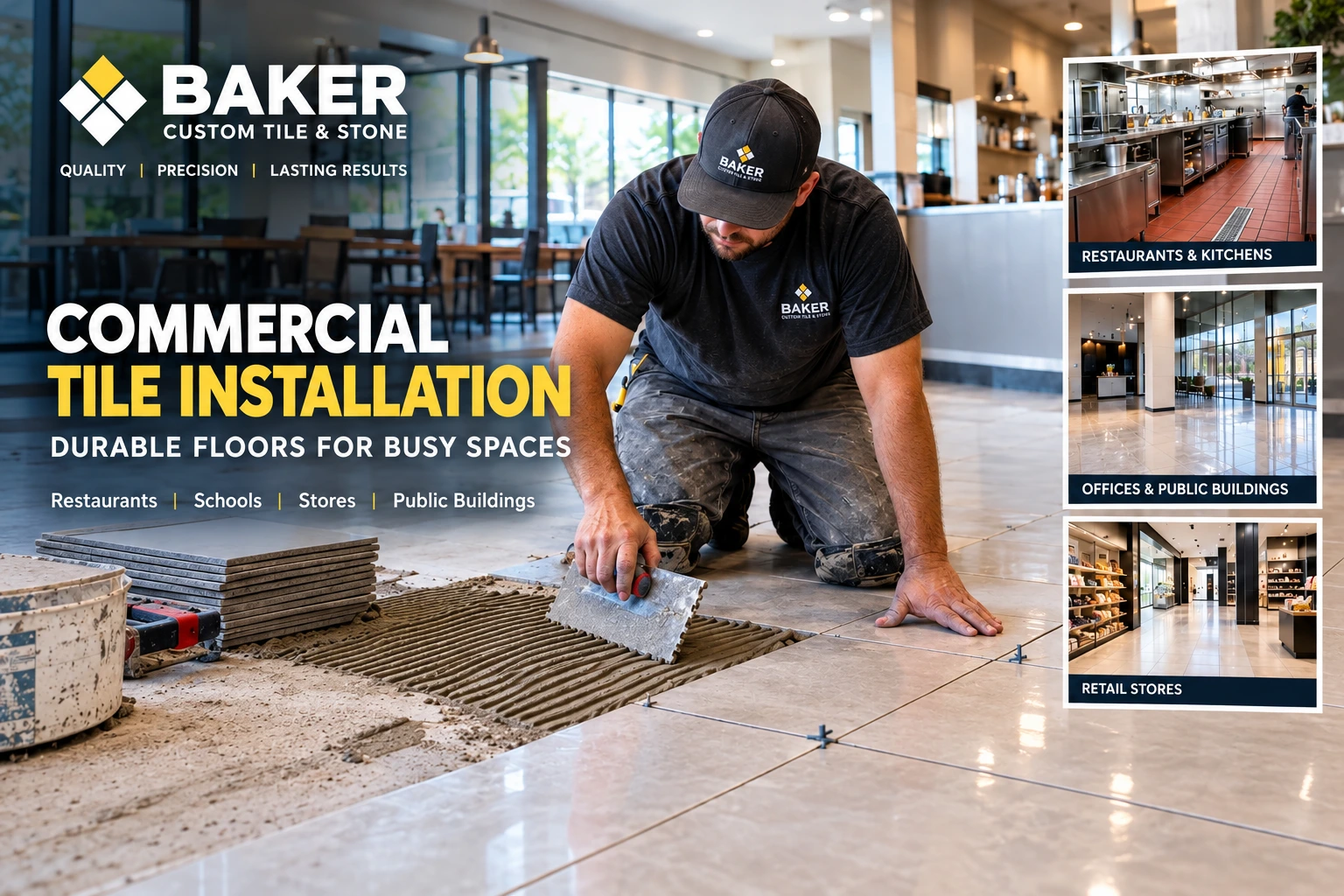
Commercial tile installation means setting tile in places like restaurants, schools, stores and public buildings, where people walk all day and the floor has to take it. Homeowners ask us how it differs from a house job. More traffic, tighter deadlines, more people to coordinate with, and much less room for mistakes. Here’s how we see it.

Latest Blog

Commercial Tile Installation in Fresno County

Commercial tile installation means setting tile in places like restaurants, schools, stores and public buildings, where people walk all day and the floor has to take it. Homeowners ask us how it differs from a house job More traffic, tighter deadlines, more people to coordinate with, and much less room for mistakes. Here’s how we see it.

We’ve pulled up floors where the concrete wasn’t flat, where it was still damp, and where somebody tiled right over old adhesive and called it done. Doesn’t matter how good the tile was. It cracks, pops loose, or sounds hollow underfoot. Then the owner pays for demo and does the whole thing twice.
Professional commercial tile installation for restaurants, retail stores, and public buildings in Fresno County, California.
So we put real time into prep. Grinding, leveling, cleaning, moisture checks. Nobody posts photos of it, and clients rarely see it. It’s also the reason a floor still looks right years later.

Start with the floor underneath

When a commercial tile floor fails, it’s almost never the tile. It’s the slab.
We’ve pulled up floors where the concrete wasn’t flat, where it was still damp, and where somebody tiled right over old adhesive and called it done. Doesn’t matter how good the tile was. It cracks, pops loose, or sounds hollow underfoot. Then the owner pays for demo and does the whole thing twice.
So we put real time into prep. Grinding, leveling, cleaning, moisture checks. Nobody posts photos of it, and clients rarely see it. It’s also the reason a floor still looks right years later.

What walks on it decides the tile

Most commercial floors we do end up porcelain. It’s dense, it ignores water and stains, and it takes foot traffic well. Ceramic is fine for walls and light-duty spots, but we wouldn’t put it in a busy entry.
Marble and natural stone? Gorgeous. Hard to beat in a lobby. But they need sealing and upkeep, and a lot of owners say they’ll keep up with it and then don’t. If that’s you, choose something else and save yourself the grief.

Kitchens and wet areas need slip-resistant tile. Read the rating on the spec sheet. Don’t trust the sample in your hand. Grout is the other one people skip past. Plain cement grout soaks up grease in a restaurant kitchen and stains fast. Epoxy costs more up front, and in a kitchen that gets washed down every night it’s worth it. If you’re also planning new kitchen countertops it’s smart to schedule them with the tile work.

How a job usually goes

We come out first. Look at the space, read the plans if there are any, check the slab, and ask when we can be there. Then you get a written bid.
A lot of commercial tile gets done at night or on weekends, because most businesses can’t just close. We plan around that. Sometimes it makes more sense to work in sections so you can stay open, and we’ll lay it out that way.
After demo and prep comes layout, and this is the part that gets rushed. Where the pattern centers, where the cut tiles land. You can spot a floor where nobody thought about it. Then comes setting, grouting, sealing what needs it, cleanup, and a walkthrough with you to catch anything we need to fix.

Movement joints and cure time

Owners push back on these two more than anything else, usually because of the opening date.

Movement joints first. Slabs and tile expand and shrink with temperature, and the Central Valley gives them plenty to deal with. In July the heat also changes how fast mortar sets, so we pay attention to that. If a floor has nowhere to move, it’ll crack where it wants to. The TCNA Handbook and ANSI standards say where joints go, and we follow them, even if it adds a day.

Then curing. We get it, you’ve got a date. But rolling heavy equipment across a floor before the mortar and grout cure can ruin the work. Plan backward from the opening date and build the cure time in. Don’t squeeze it at the end.

Why the bids don’t match

You’ll get different numbers from different contractors, and it’s not always because somebody’s playing games. Often one bid includes leveling the slab and another quietly doesn’t. Or one priced regular tile and the other priced large-format porcelain, which takes a lot longer to set right. Night work costs more than day work. A busy pattern costs more than a straight run.
Here’s what we tell people: lay the bids next to each other and compare what’s included, not the bottom line. If one’s way lower, find out why before you say yes. Prep is the first thing that gets dropped.

What to check before you hire

Look up the license on the CSLB website Two minutes. Ask to see the insurance paperwork. If it’s a public job, make sure DIR registration is in place. Then ask who they’ve done commercial work for, and call one of those people. Someone who does beautiful kitchen remodels isn’t automatically the right pick for a college campus. And notice how fast they respond while you’re still shopping. If it’s slow now, it won’t get faster once they have your deposit.

Who we are

Baker Custom Tile & Stone is run by Gabriel Baker, a licensed, bonded and insured Journeyman tile setter based in Sanger. License #1124771, DIR #2000013787. Gabriel has been Foreman on commercial jobs including Table Mountain Casino, Fresno City College West Campus, UC Merced, the Fresno FAX Bus Station, Mike’s Pizzeria, Piemontes Deli and Bedrosians Tile & Stone. A casino and a neighborhood deli have nothing in common, but the work is the same on both: prep it right, use the right materials, finish when you said you would. You can see more on our commercial tile installation page.

Here’s what a couple of customers told us. One said Gabriel sent weekly updates on what was owed and what was left, so she always knew where things stood. Another said the crew left the house livable every day, and the work areas were so clean it looked like nobody had been there. Those were home jobs, but we run commercial ones the same way. More feedback is on our reviews page.

Questions we get a lot

How long does it take?

Depends. A small restroom might be a couple of days. A big space done in sections can run weeks. Once we’ve walked it, we’ll put a schedule in writing.

Can you work while we’re open?

Most of the time, yes. We can section off an area or come in after hours. Tell us up front so we plan for it.

What tile for a restaurant floor?

Slip-resistant porcelain. Epoxy grout in the kitchen, because regular grout soaks up grease.

Do you have DIR registration?

Yes, It’s required on public works in California.

How do I get a bid?

Call (559) 770-5732 or use the contact form. Tell us what the space is, where it is, roughly how big, and when you need it done.

Planning a commercial tile project?

We work in Fresno County and across Central California. Check out our commercial page and customer reviews, then request a free bid or call (559) 770-5732.

Scroll to Top